

Convalescing With Guitars
A guitar project with minimal effort and maximum enjoyment.

I had minor foot surgery on 12/18. Technically, “first metatarsophalangeal joint fusion with a calcaneal bone graft harvest.” Or, more simply, two joints (with little cartilage left) are fused together to prevent arthritis, and bone spurs removed.
I have been off my foot for two weeks, and have at least two more until I can put weight on that foot again. I will be on the couch or on crutches for a bit.
In my drug-induced haze, I found myself on Reverb.com, looking at guitars. I noticed a Squier Sonic Mustang HH guitar body for sale (in my favorite guitar color: black). It was “loaded,” meaning it had all hardware and electronics installed. Most likely, somebody bought a Squier Sonic Mustang (which can be purchased for $200-$230 online) just for the neck, and sold off the body to recoup costs.
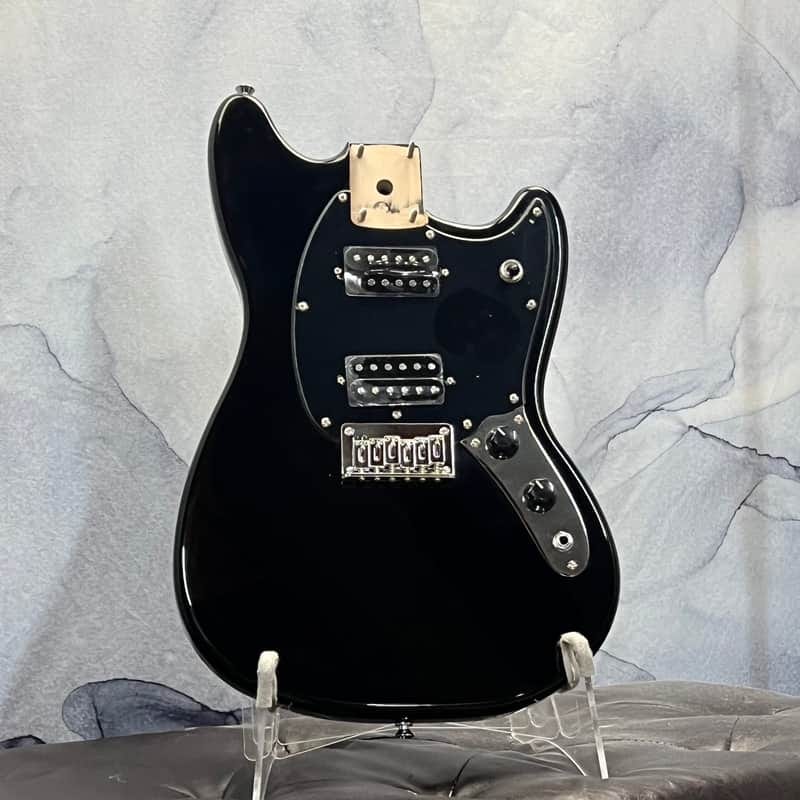
The Sonic series is Fender/Squier’s “beginners” line of guitars, but the Mustang models in particular have been popular mod platforms.
The Fender Mustang was first introduced in 1964 as a “student guitar,” but by the 70s, it could be seen in the hands of professionals: David Byrne, Todd Rundgren, Dave Alvin. By the 80 and 90s, many indie/alternative guitarists were using them because they were much cheaper than a Strat or a Tele; Blixa Bargeld, Thurston Moore, Belinda Butcher, Liz Phair, John Frusciante… and of course, Kurt Cobain. It has since become fairly common to see a Mustang on stage.
The Mustang has an asymmetrical body shape, which is commonly referred to as an “offset” guitar. It also has a shorter “scale” than a Strat or Tele (in this case, scale refers to the distance from the nut to the saddle). Some people just prefer that shorter scale, especially if they have smaller hands.
I’ve always loved the Mustang. A close friend had a vintage Fender Mustang in Olympic White, which became a nice white/yellow/buttercream by the time I played it in the early 90s. I tried to build one shortly after playing his, but it didn’t come out very nice.
Enter the Sonic Mustang HH (the HH means it has two humbucker pickups instead of the traditional single coil pickups). These guitars are cheap and easy to work on. So I decided to take the plunge. I bought the body.
I soon found another short-scale Squier neck for sale. Not from a Mustang, but from a Jaguar (another offset that I happen to love). Squier’s Classic Vibe line is excellent, costing more than the Sonic series but cheaper than a real Fender. This neck came from a 70’s-style Classic Vibe model, so instead of dot inlays, it featured block inlays and binding along the fretboard.
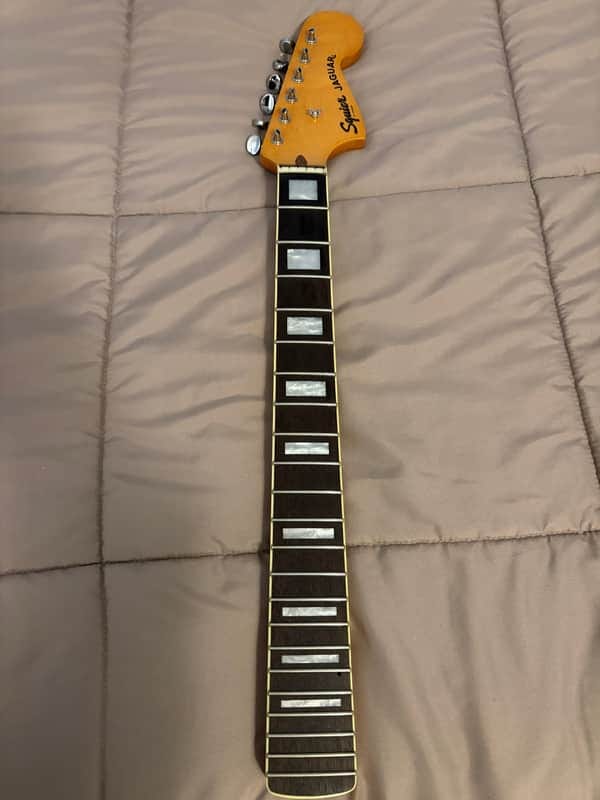
In theory, all I would need were strings. I decided to take the plunge for a guitar that I could modify to my liking. I made a mock-up in Photoshop:
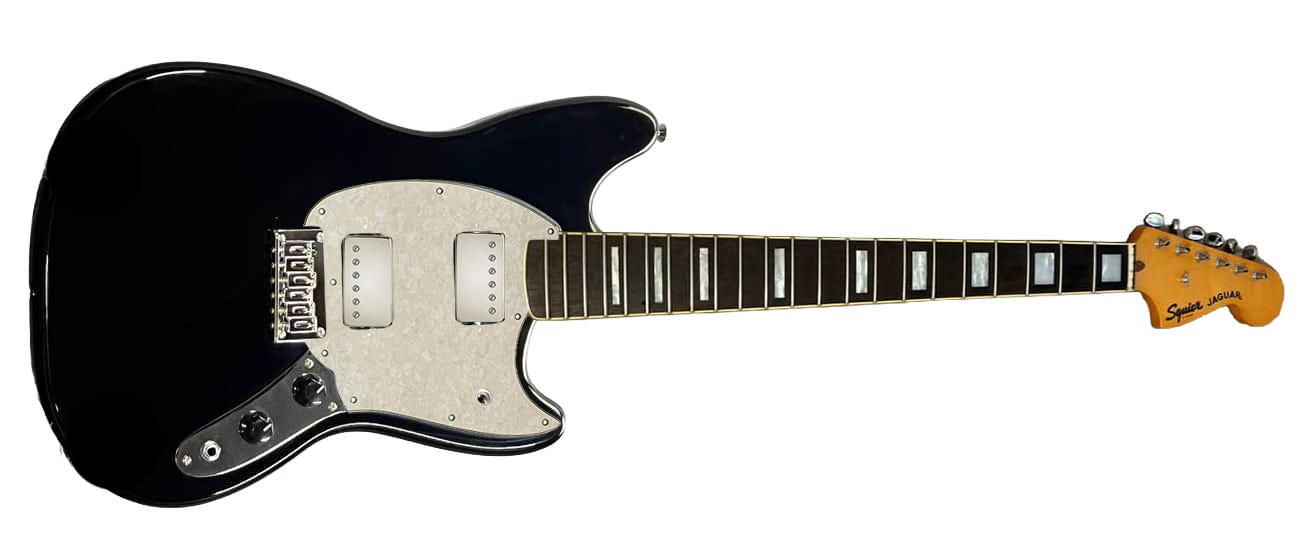
This would require 1) chrome pickup covers and 2) an aged-white pearloid pickguard. Those were easy enough to obtain for $20 total. Here is the guitar in its current state:
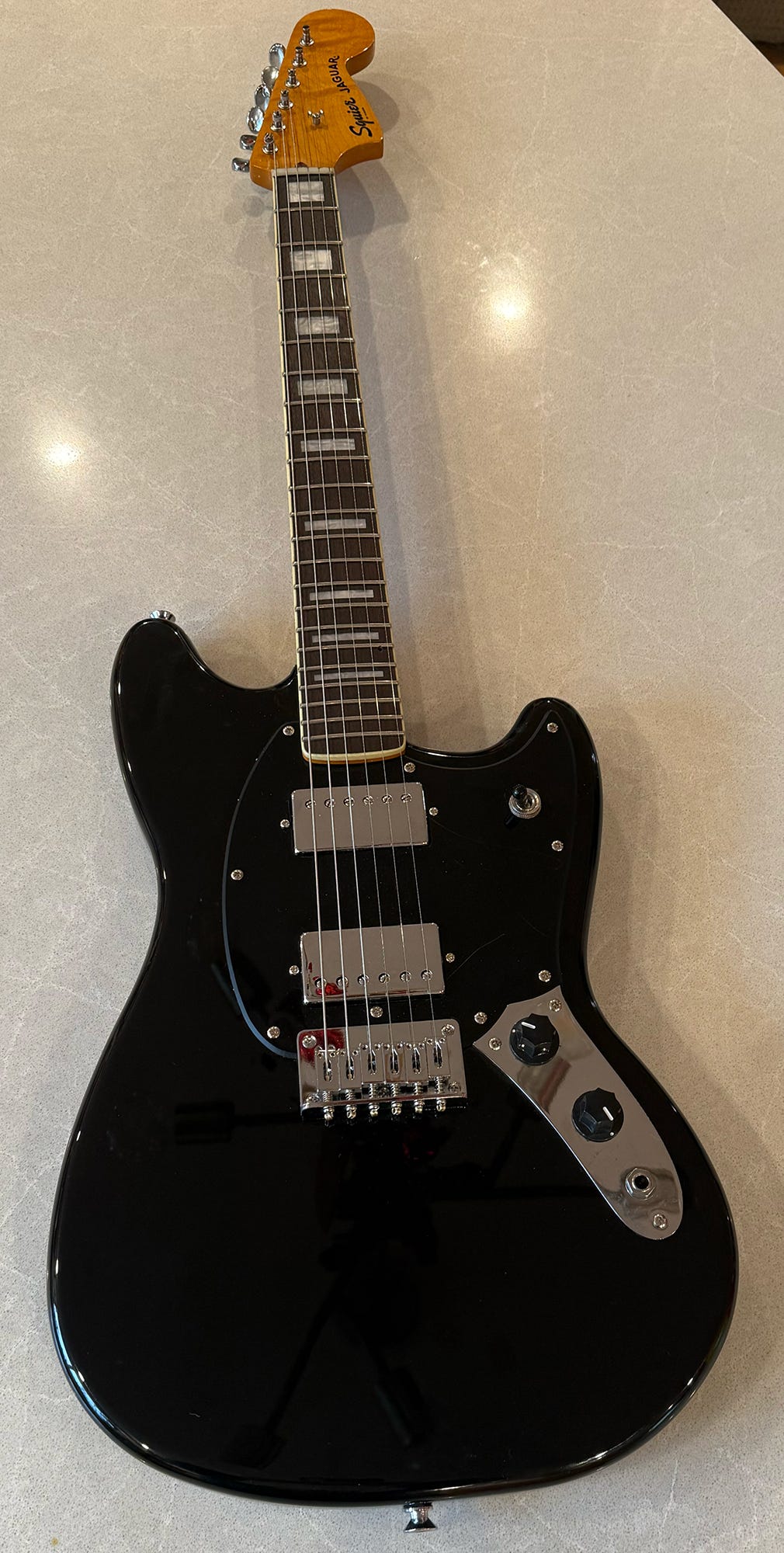
As you can see, I didn’t replace the pickguard yet. That’s because the holes for the humbuckers need to be enlarged in order to fit the chrome covers. I grabbed my trusty pocket knife, and proceeded to enlarge them by hand on the stock black pickguard, just to test the waters.
Simply bolting the two pieces together does not make for a guitar that is properly set up. The neck had a slight backbow, so I had to adjust the truss rod to straighten it out a little bit. The saddle height had to be adjusted so that the strings weren’t too high or two low from the fretboard. And finally, the saddles had to be adjusted length wise, so that the guitar’s intonation would be correct.
The only issue that I am having is the nut. The previous owner probably used heavier strings, so my preferred string gauge sits deeper in the nut slots than normal. I ordered a pre-slotted nut and some inexpensive files, and will replace that as soon as possible.
Phase one is complete!
Phase two options:
Replace the current nut with a pre-slotted bone nut (coming very soon)
An additional string tree, so that the G and D strings have a steeper angle above the nut (very soon as well)
Aged-White Pearloid Pickguard (I will have to enlarge the holes again)
Replaced all electronics with higher quality wire, plus Switchcraft components (output jack, pickup selector switch, volume and tone pots) and an Orange Drop capacitor. Not required, but will make a big difference in terms tone and reliability)
Copper shielding tape in the body cavity and the bottom of the pickguard, to shield from radio interference.
The saddles are made of cheap zinc pot metal. I plan to replace them with aftermarket brass saddles. This should improve tone and sustain.
I may try different volume and tone knobs, but I may like the current “vintage” style better.
GFS pickups are way cheaper than boutique pickups, so I may try different types down the road.
There you have it. I could go crazy (if I’m not already) but I can’t justify putting a lot of money into a Sonic Mustang. But I can justify customizing it to my liking. Stay tuned for more.